Beyond the Panel: How TLS Engineered a Lightweight, Substrate-Free Ceiling System
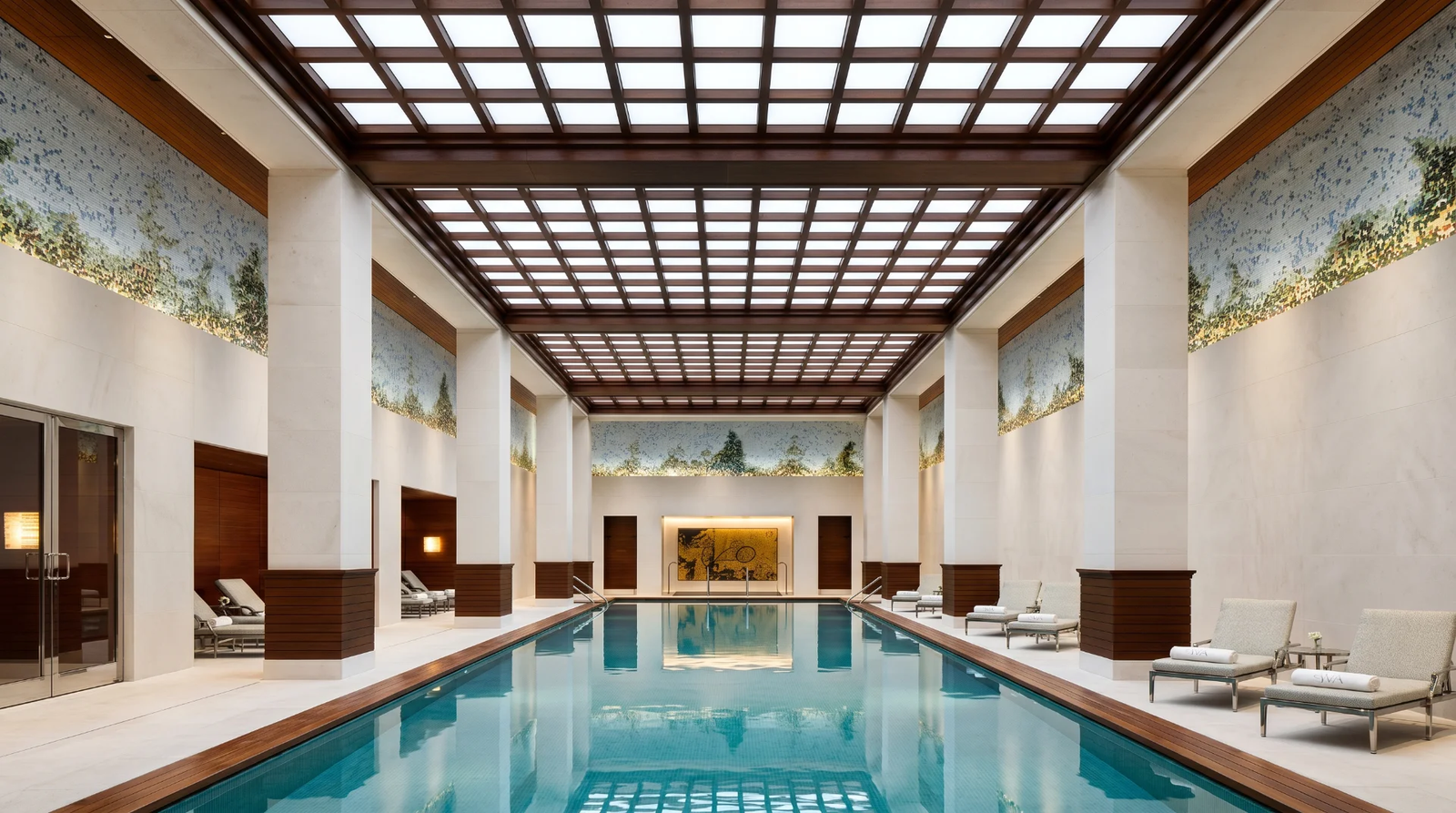
Large-scale illuminated ceilings are rarely difficult because of the lighting itself.
The real engineering challenge is how to build a large illuminated surface that remains aligned, stable, lightweight, serviceable, and visually consistent, without turning the ceiling into a massive structural assembly.
As the size of a ceiling installation increases, small issues become major ones. A slight amount of sagging can become very noticeable across a large span. Small alignment errors can accumulate from one section to the next. Additional structural panels add weight. More weight requires more support. More support can mean more installation time, more complexity, and greater demands on the existing building structure.
Traditional illuminated ceiling systems often address these challenges by creating a rigid substrate behind the lighting system.
That substrate may be aluminum, Dibond®, composite panel, or another rigid material designed to carry the LEDs and maintain their position.
It works, but it comes with a fundamental trade-off:
The larger the illuminated surface becomes, the more material you need to support the lighting system.
TLS approached the problem from a different direction.
Instead of asking, “How do we build a heavier panel strong enough to hold the lighting?”
TLS asked:
“How can we engineer the lighting system itself to become the structural element?”
That question led to the development of the TLS — Tension LED System.
The Challenge With Traditional Panel-Based Systems
In a conventional large-format illuminated ceiling, the LEDs are commonly mounted onto a rigid backing.
The panel performs several functions:
- Holds the LED components in position
- Maintains dimensional stability
- Provides a surface for installation
- Helps control the geometry of the lighting system
- Transfers the weight of the system to the building structure
For smaller installations, this approach can be practical.
But when the ceiling becomes hundreds or thousands of square feet, or when the design incorporates large organic shapes, clouds, curves, or complex geometries, the substrate itself becomes a significant part of the engineering challenge.
More substrate means more weight.
And more weight can lead to:
More structural support → more hardware → more installation time → more complexity → more impact on the existing building.
There are also practical consequences.
A rigid panel can make access to the LED system more difficult. Maintenance may require reaching behind or removing sections of the assembly. LED replacement can become more labor-intensive. Acoustic materials may have to be interrupted by rigid substrates. Transportation and handling becomes more complicated.
And as the ceiling gets larger, the panel is no longer simply a mounting surface.
It becomes a structural system.
TLS Takes a Different Approach
TLS stands for Tension LED System.
The concept is relatively simple:
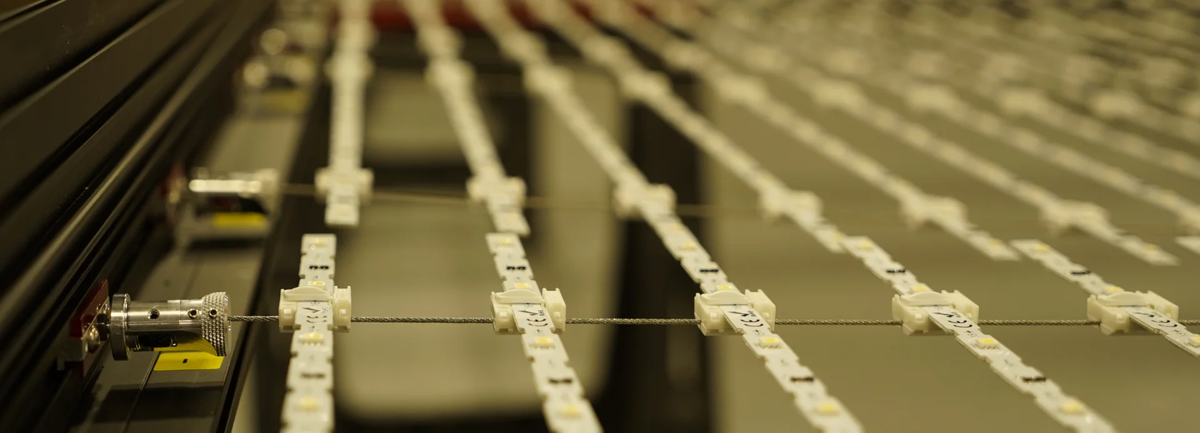
Instead of using a heavy rigid substrate to hold the LED grid, TLS uses tensioned cables and a lightweight aluminum structure to control the geometry of the lighting system.
- The result is a fundamentally different architecture.
- The lighting grid is supported through strategically tensioned cables, lightweight PCB holders, LED strips, and engineered support elements.
- The cables create the tension.
- The lightweight aluminum structure organizes and transfers that tension.
- The LED grid follows the engineered geometry.
And strategically positioned support clips control sagging across the surface.
The result is a lighting system that does not need a massive continuous substrate to maintain its form.
Turning the Lighting Grid Into the Structure
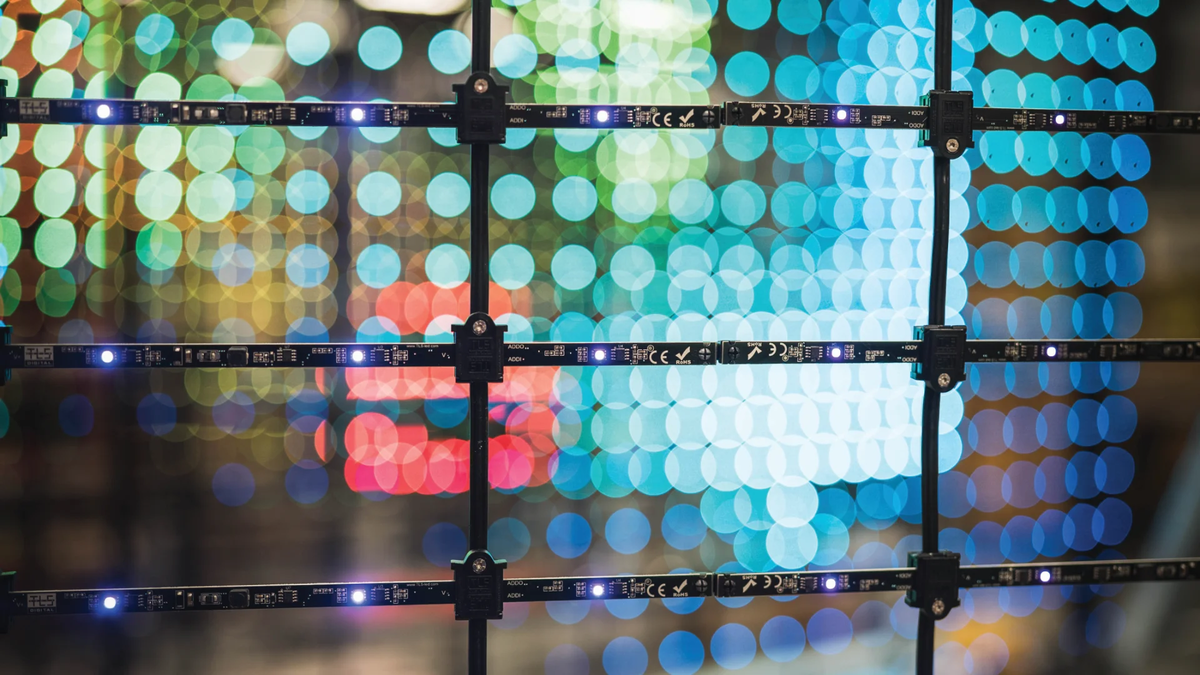
One of the most important differences in the TLS approach is that the system is engineered as an integrated assembly rather than treating lighting as something simply attached to a large panel.
The tension cables can run between structural points, depending on the geometry and application, creating a controlled supporting network across the ceiling.
The lightweight LED grid is then positioned within that network.
This creates a system where:
- Tension provides stability.
- The aluminum structure provides geometry.
- The LED grid provides illumination.
- Support clips control deflection.
Lightweight Does Not Mean Uncontrolled
A common misconception is that removing a rigid substrate means sacrificing alignment or structural control.
TLS does the opposite.
- The system is engineered around the geometry of the installation.
- The position of the LED elements, cable tension, PCB holders, crossbeams, and support clips are all coordinated to create a controlled lighting surface.
- This allows TLS to maintain consistency across large areas without relying on a continuous heavy backing panel.
- The objective is not simply to make the system lighter.
- The objective is to make it lightweight while remaining engineered, repeatable, and predictable.
Consistent Alignment Across Large Areas
Largescale ceilings magnify dimensional errors.
If one small section is misaligned by a few millimeters, that error can become increasingly visible as multiple sections are connected together.
TLS addresses this by establishing the geometry of the lighting system through the tension structure and engineered mounting points.
This creates a repeatable installation methodology.
Whether the project is:
- A large illuminated cloud
- A linear ceiling
- An organic architectural form
- A curved installation
- A multi-section ceiling
- A custom architectural lighting feature
The same engineering principles can be applied.
The result is a system designed to maintain the intended geometry from one installation to another.
Managing Sagging Without Building a Heavy Structure
Sagging is one of the biggest concerns with large-format illuminated surfaces.
A traditional approach often responds by increasing the rigidity of the substrate, TLS instead uses distributed support.
Strategically positioned support clips and tension elements help control the deflection of the LED grid. This means the system doesn’t need to depend on one enormous rigid panel to remain flat or visually consistent, the structure works as a network.
And that network can be engineered according to:
- Span
- Shape
- Overall dimensions
- Lighting density
- Mounting conditions
- Cable configuration
- Required visual uniformity
The result is a large illuminated surface that can remain visually controlled without unnecessarily adding mass.
The Electrical System Is Part of the Engineering
TLS is not simply a mechanical mounting solution.
The electrical architecture is also designed around the lightweight system, the LED strips and PCB holders form an integrated distribution network, allowing low-voltage power to be distributed throughout the illuminated area.
The system is engineered to control the electrical conditions across the installation so that the LED output remains consistent across the designed dimensions, this is particularly important in large illuminated ceilings.
A lighting system can be mechanically perfect but still fail visually if the light output varies significantly from one area to another. The goal of TLS is therefore not simply:
“Put LEDs on a ceiling.”
The goal is:
Create a controlled illuminated surface where mechanical geometry, electrical distribution, and optical performance work together.
Less Weight Can Mean More Than Easier Installation
Reducing weight isn’t only about making installation easier.
It can fundamentally change the relationship between the lighting system and the building.
A heavy ceiling assembly requires the building structure to carry that additional load.
That may require:
- Additional suspension points
- Reinforced structural members
- More anchors
- Heavier framing
- More installation labor
- More engineering coordination
An ultra-light TLS system can reduce the amount of structural intervention required to support the illuminated feature.
That can be particularly valuable in existing buildings where the structure was never designed to carry a large illuminated architectural ceiling.
The lighter the system, the less infrastructure that may be required to support it.
In the end, every project still requires appropriate structural engineering and verification of the actual building conditions and loads.
Accessibility and Maintenance
Another major advantage becomes apparent after the installation is complete.
A ceiling system should not only be easy to install.
It should be easy to live with.
LED systems eventually require service. Drivers, controllers, connections, and individual lighting components may need inspection or replacement.
With a conventional panel-based system, the rigid substrate can become a barrier between the technician and the lighting system.
TLS is designed around accessibility.
Because the system does not depend on a massive continuous backing panel, service access can be integrated into the architecture of the installation.
This can simplify:
- LED replacement
- Electrical troubleshooting
- Driver access
- Inspection
- Component maintenance
- Future modifications
The result is a system designed not just for installation day, but for the entire life of the ceiling.
Acoustics Without Sacrificing Lighting
Architectural ceilings increasingly have to perform multiple functions.
They need to provide:
Light + Acoustics + Architecture + Aesthetics
A large rigid substrate can interfere with the acoustic behavior of a ceiling system.
TLS’s lightweight, substrate-free approach can allow the acoustic material to remain a more integral part of the overall ceiling design rather than being covered by a continuous rigid backing panel.
This is especially important for products such as acoustic illuminated clouds, where the objective is not simply to create light, but to combine lighting performance with acoustic and architectural performance.
The lighting system becomes integrated with the architectural material rather than replacing it.
From Flat Rectangles to Architectural Freedom
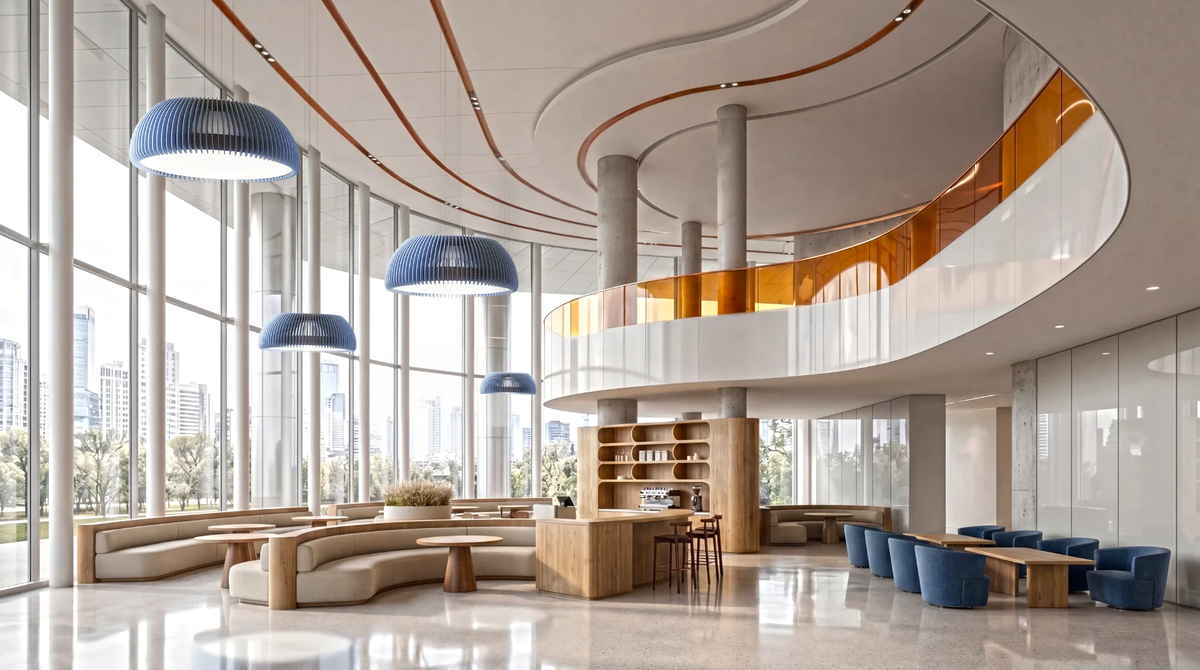
Once a lighting system is no longer dependent on a rigid panel, designers gain additional freedom.
The system can be engineered around different shapes and geometries.
TLS can be adapted to architectural forms that may be difficult or expensive to construct using conventional rigid-panel methods.
- Curves.
- Organic shapes
- Large clouds
- Irregular geometries
- Multi-level installations
- Custom architectural forms
The underlying engineering principle remains the same:
Create the geometry first. Engineer the tension and support system around it. Then integrate the lighting.
This gives architects and lighting designers more freedom to pursue the original design intent without automatically being limited by the weight and construction requirements of a rigid substrate.
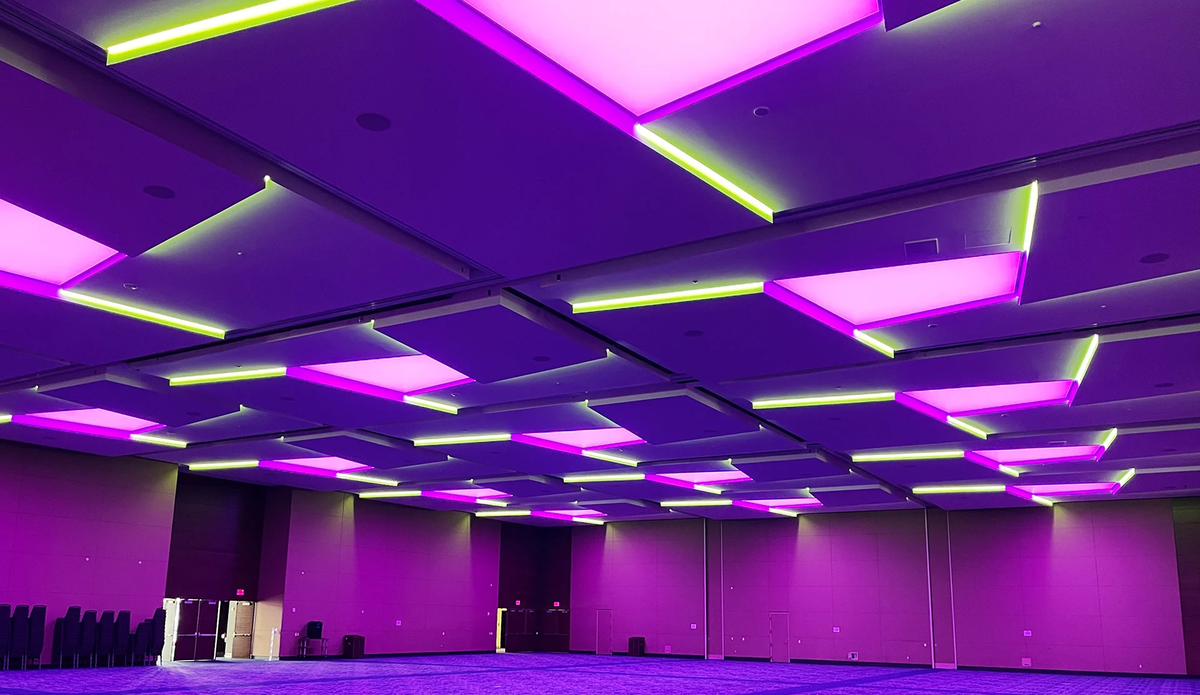
From Site to Site: Engineering Consistency
A successful architectural lighting system cannot depend on improvisation at every installation.
Large projects require repeatability.
TLS approaches each installation as an engineered system with defined components, dimensions, mounting locations, tension requirements, lighting distribution, and support strategies.
This allows the same fundamental technology to be adapted to different:
- Ceiling dimensions
- Architectural shapes
- Mounting conditions
- Lighting densities
- Project requirements
The result is a more controlled transition from engineering to fabrication to installation.
The objective is consistency, not just on one project, but from project to project.
Turnkey Engineering Makes the Difference
The advantage of a tension-based system becomes even more significant when it is delivered as a complete turnkey solution.
TLS can engineer the complete system around the application rather than supplying isolated lighting components.
That means the mechanical structure, tension system, LED grid, electrical distribution, support elements, and architectural requirements can be considered together.
This eliminates the common problem of having one supplier responsible for lighting, another for structure, another for the ceiling material, and the installer left to figure out how everything comes together.
TLS’s philosophy is different:
Engineer the complete system first. Then build the system around the architectural requirement.
The Result: More Light, Less Structure
The fundamental philosophy behind TLS can be summarized in one idea:
Don’t build a heavy structure to support the lighting.
Engineer the lighting system so it can be supported by a lightweight structure.
This approach can provide significant benefits for large-scale illuminated ceilings:
- Reduced overall weight
- Less structural impact
- Faster installation
- Simplified handling
- Better accessibility
- Improved serviceability
- Greater architectural freedom
- Integration with acoustic materials
- Consistent LED alignment
- Controlled sagging
- Repeatable installation methodology
- Scalable engineering for large dimensions
The result is not simply a lighter ceiling; it is a different way of thinking about illuminated architecture.
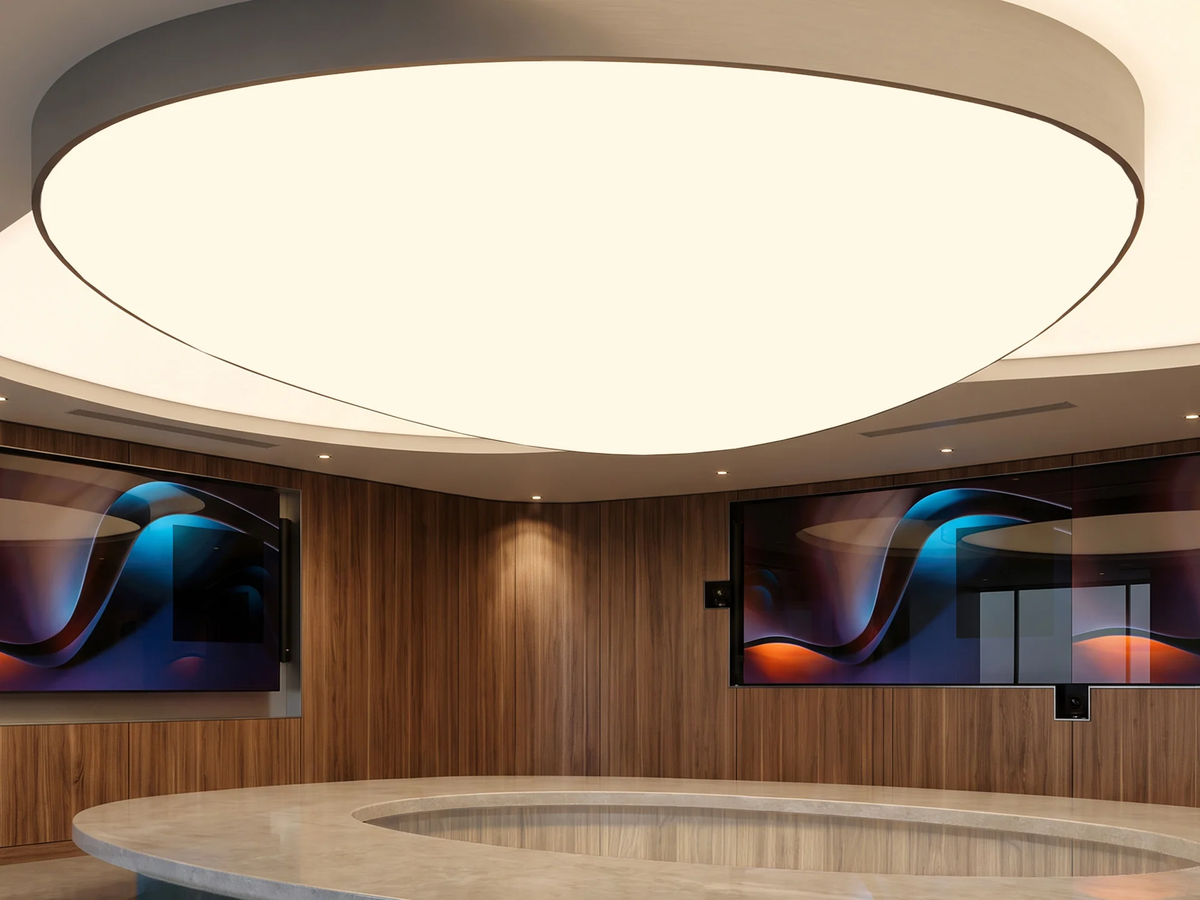
The Future of Large-Scale Illuminated Ceilings
As architectural lighting continues to become larger, more integrated, and more complex, the traditional concept of putting LEDs onto a rigid panel becomes increasingly limiting.
The future is not necessarily about making the panel stronger.
It may be about eliminating the panel altogether.
TLS demonstrates what happens when the lighting system, mechanical structure, electrical distribution, and architectural material are engineered as one integrated solution.
A substrate-free approach can turn a heavy illuminated ceiling into a lightweight architectural system.
And that is the fundamental idea behind the TLS Tension LED System:
Tension instead of mass.
Engineering instead of excess structure.
Integration instead of another layer.
Light where you need it, without unnecessary weight.
For largescale illuminated ceilings, the question is no longer simply how to mount the LEDs.
The better question is:
How can we engineer the entire ceiling to perform with less structure, less weight, and greater architectural freedom?
That’s where TLS begins.