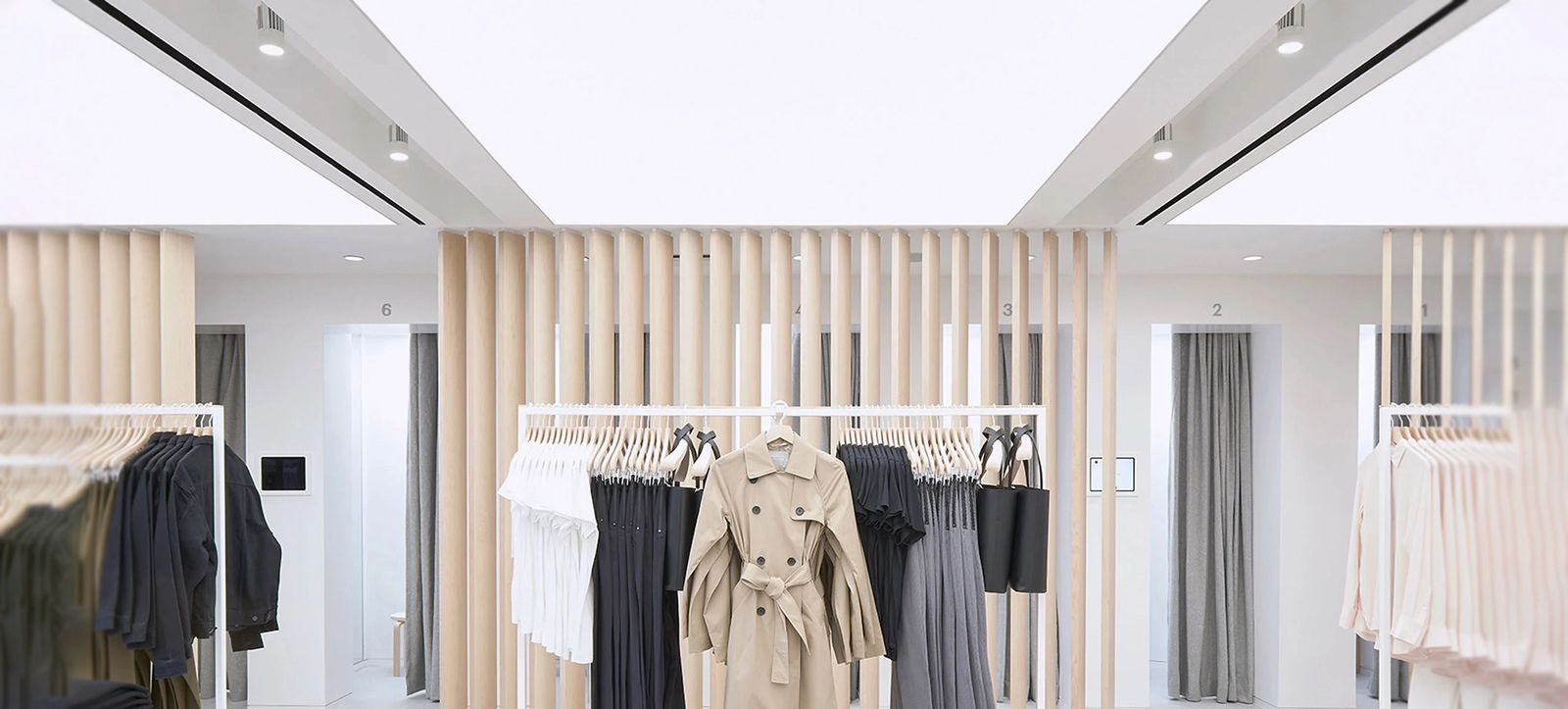
Why Do Illuminated Ceilings Get Hotspots?
The Science Behind Truly Homogeneous Light
One of the most common challenges in architectural backlighting is hotspotting: areas that appear brighter, darker, or sometimes even slightly different in color from the surrounding surface. An illuminated ceiling should look like a surface of light, not a collection of LEDs.
For architects, lighting designers, and manufacturers, the challenge is not simply to produce enough light. The real challenge is to create a visually seamless, homogeneous luminous surface.
And that is much more complicated than it may first appear.
At TLS, we approach this challenge by treating the LED source, optical distance, diffuser, reflector, geometry, and light distribution as one integrated lighting system. Our LumiCloud™ platform is specifically engineered to provide uniform, edge-to-edge illumination, including in customized architectural forms.
What Exactly Is a Hotspot?
A hotspot is essentially a visible difference in luminance or color across an illuminated surface.
The human eye is extremely good at detecting contrast. Even when a lighting system produces plenty of light, small variations can become noticeable when they are repeated across a large ceiling.
A hotspot can appear as:
- Visible LED points
- Bright and dark areas
- Bands or patterns
- Brighter edges
- Darker corners
- Uneven illumination around curves
- Shadows within complex shapes
- Color-temperature variations
The goal, therefore, is not simply to make a surface bright.
The goal is to make the light itself disappear into the architecture.
What Creates Hotspots?
There is rarely one single cause.
Hotspotting is usually the result of several elements interacting with each other.
LED Density and LED Pitch
The distance between individual LEDs is one of the first things to consider.
When LEDs are positioned too far apart, the diffuser has to work harder to blend the individual sources into one continuous field of light.
When the LED pitch is reduced, the light sources are closer together and the illumination has more opportunity to blend before reaching the diffuser.
But adding more LEDs is not automatically the solution.
A system can contain thousands of LEDs and still produce hotspots if the optical distance, diffuser, reflector, or geometry are not properly engineered.
This is why LED density needs to be considered together with the rest of the optical system.
The Distance Between the LED and the Diffuser
This is one of the most important relationships in backlit lighting.
Imagine placing an LED directly behind a translucent material. The light source is close enough that the eye can still distinguish the individual LED.
Now increase the distance.
The light has more room to spread and overlap with the light coming from neighboring LEDs. The individual sources begin to blend into one another.
This creates an important principle:
Optical distance is not wasted space; it is part of the lighting system
The correct distance depends on several variables, including LED pitch, optical distribution, diffuser characteristics, required lumen output, and the geometry of the fixture.
There is no single distance that works for every application.
The Diffuser: More Diffusion Is Not Always Better
The diffuser is another critical part of the equation.
It is tempting to think that simply using a more opaque material will solve hotspotting.
It can help, but there is a trade-off.
A material with greater diffusion can scatter the light more effectively and help hide the individual LED sources. However, greater diffusion can also reduce light transmission and therefore reduce the amount of useful light reaching the room.
The objective is not to choose the most opaque diffuser possible.
It is to find the right balance between:
Light transmission + diffusion + LED spacing + optical distance
This becomes even more important when working with specialized architectural materials, acoustic media, printed surfaces, perforated materials, or other translucent surfaces.
A clear material provides an extreme example.
If you illuminate clear glass from behind, the light source can remain visible because the material provides very little scattering. Increasing the distance can improve the appearance, but it does not fundamentally change the optical characteristics of the glass.
Why the human eye notices hotspots so easily
The human visual system is remarkably sensitive to contrast and pattern recognition. Even when luminance differences are relatively small, repetitive bright and dark regions across a luminous ceiling can become immediately noticeable. This is why uniformity requirements in architectural lighting are often more demanding than simply achieving target illumination levels.
What Happens Behind the Diffuser?
This is one of the most overlooked aspects of illuminated ceilings. It is easy to think about the light traveling from the LED toward the diffuser, but what happens when the light reaches the diffuser? Not all of the light passes through, some of it is transmitted, and some is reflected back into the cavity. And what happens to that reflected light can have a major effect on uniformity.
A useful way to visualize this is to imagine millions of tiny ping-pong balls moving through the lighting cavity. Some travel directly toward the diffuser, while others bounce off the diffuser and travel back toward the reflector. They can then bounce again before returning toward the diffuser. The more effectively this optical environment is controlled, the more opportunity the light has to redistribute itself before reaching the viewer.
Note that highly reflective cavity surfaces help recycle light that would otherwise be absorbed. Multiple reflections allow light energy to redistribute more evenly throughout the cavity before reaching the diffuser, reducing localized intensity variations and improving uniformity.
The Reflector Is Part of the Lighting System
This is why the inside of the fixture matters.
If the surfaces behind the diffuser absorb the light, photons that could have contributed to uniformity are simply lost.
A properly engineered reflective cavity can redirect that light back into the system.
This can help reduce contrast between areas close to the LED source and areas farther away from it.
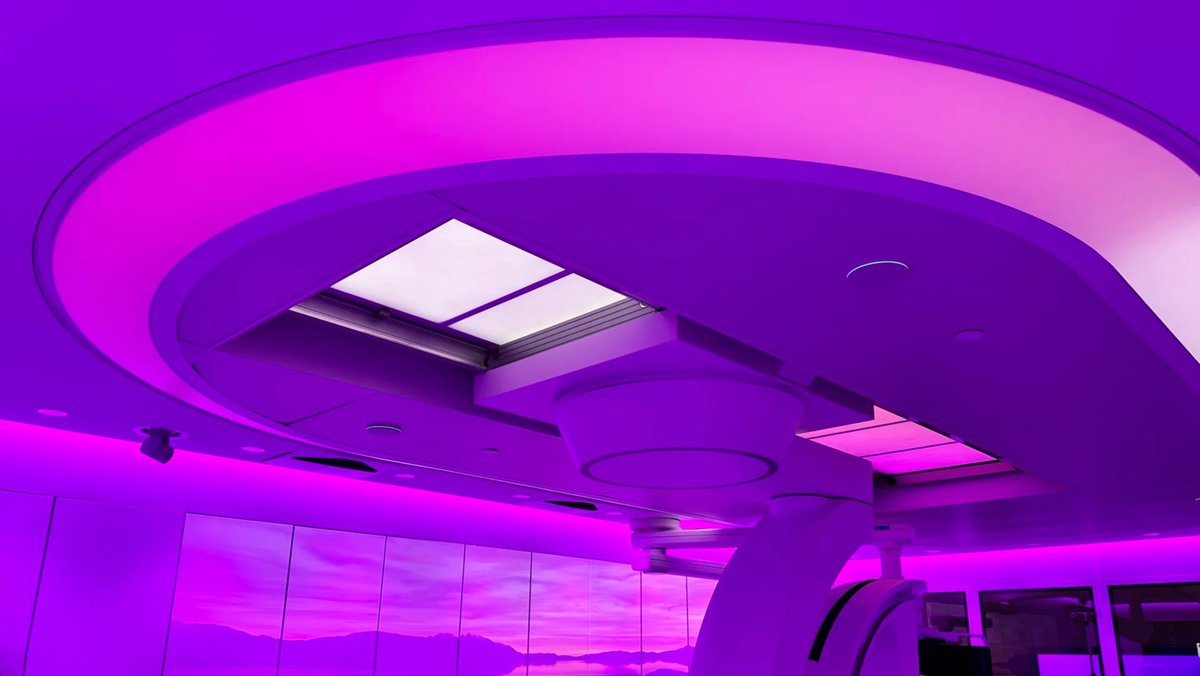
Geometry Changes Everything
A perfectly flat rectangle is relatively predictable.
Architectural lighting rarely stops there.
Designers increasingly ask for:
- Rounded corners
- Circular forms
- Curved surfaces
- Organic shapes
- Continuous lines
- Irregular geometries
- Large custom luminous clouds
- Lighting integrated around architectural obstacles
As the geometry becomes more complex, maintaining uniform illumination becomes more challenging:
- The distance between the LED source and diffuser can change.
- The angle at which light reaches the diffuser can change.
- The amount of reflected light can change.
- Edges and corners can behave differently from the center of the fixture.
This is why a lighting system that performs well in a simple rectangular box may not perform the same way when it is transformed into an organic architectural shape.
The more architectural freedom you introduce, the more important the optical engineering becomes.
TLS LumiCloud™ Bespoke was developed around this principle, allowing customized shapes and dimensions while maintaining the underlying lighting technology.
Not Every Hotspot Is a Brightness Problem
There is another type of hotspot that is often overlooked.
Sometimes the luminance is relatively uniform, but the color is not.
LEDs can have small variations in color temperature and spectral characteristics. When a lighting system contains hundreds or thousands of LEDs, these differences can potentially become visible.
The result may look like a hotspot even though the issue is actually a subtle color variation.
This means there are really two different goals:
Luminance uniformity
The brightness should be consistent across the surface.
Color uniformity
The color appearance should also remain consistent across the surface.
A high-quality architectural lighting system needs to address both.
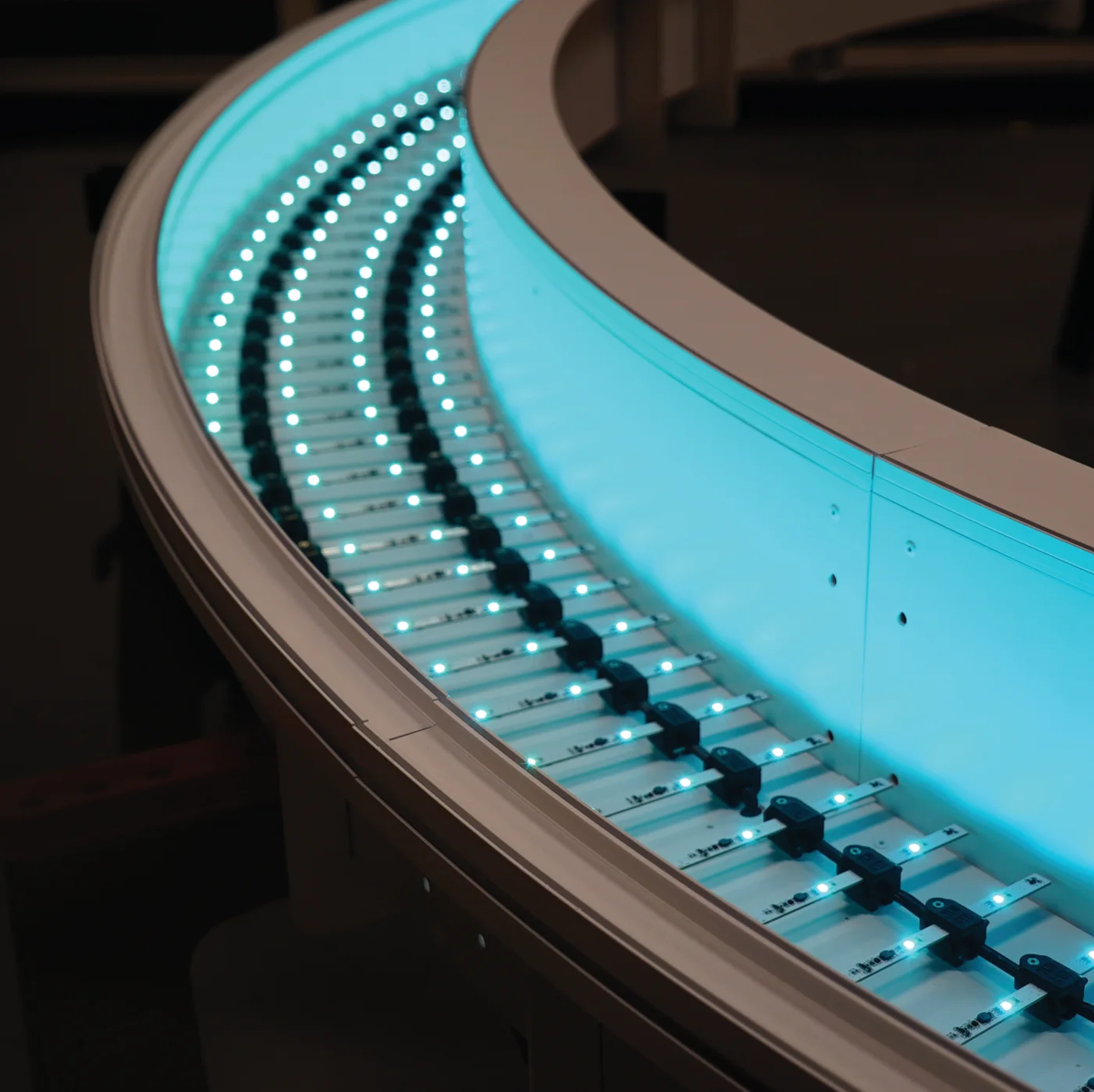
The Importance of LED Color Consistency
Maintaining color uniformity across large luminous surfaces requires tight LED binning and sufficient optical mixing. Even when luminance appears uniform, small variations in color temperature can become visible if individual sources are not adequately blended.
The goal is to ensure that the entire luminous surface appears to have one consistent color.
The TLS Approach: Designing Light as a System
At TLS, we believe hotspot control cannot be solved by one component.
It requires the entire lighting system to be engineered together.
Our Tension LED System uses a tensioned, substrate-free LED configuration that allows the lighting source to be positioned and controlled in relation to the diffuser and reflective cavity.
This creates an optical environment where the light can spread, reflect, and mix before reaching the viewer.
The result is a system designed for smooth, uniform illumination rather than simply placing LEDs behind a material. TLS describes its patented technology as being designed to evenly illuminate luminous ceiling panels, with custom board spacing optimized according to diffuser material, setback, and lumen requirements.
Why the TLS Tension System Matters
Traditional lighting construction often relies on a rigid substrate with LEDs mounted to it.
TLS takes a different approach.
The tensioned LED system creates flexibility in how the LED source is positioned within the lighting cavity. This becomes particularly valuable when the final illuminated surface is large, custom-shaped, curved, or organic.
The system can be engineered around the specific requirements of the project, including:
- LED spacing
- Diffuser characteristics
- Optical setback
- Lumen requirements
- Fixture geometry
- Edge conditions
- Reflective surfaces
This is one of the reasons TLS can approach customized luminous architecture differently from a conventional lightbox.
Controlling the Edges
Edges deserve special attention.
In many illuminated systems, including illuminated ceiling systems, the center of the fixture can look excellent while the perimeter begins to show variations.
This happens because the optical environment changes near the edge.
There is less surrounding area for light to mix.
The geometry changes.
The reflective environment changes.
And the relationship between the LED source and diffuser can become different.
TLS considers these edge conditions as part of the overall optical design. The goal is not simply to make the center of the fixture uniform, but to achieve edge-to-edge illumination with minimal visually distracting hotspots.
One System, Many Variables
Ultimately, homogeneous illumination is a balancing act.
You can think of it as an equation:

Visual Uniformity
Changing one variable can affect the others.
For example, if a diffuser has higher transmission, you may need to reconsider LED spacing or optical distance.
If the geometry becomes more complex, the LED layout may need to change.
If the optical distribution changes, the required setback may change.
There is no universal recipe.
The system has to be engineered for the application.
From Lighting Fixture to Architectural Surface
This is ultimately what architectural lighting is trying to achieve.
The objective is not for people to look at the LEDs.
It is not for them to see the diffuser.
It is not for them to notice the reflector.
It is not even for them to think about the lighting fixture.
They should simply experience the architecture.
A luminous ceiling should feel like:
Light.
Not:
LEDs behind fabric.
That distinction becomes especially important when lighting is integrated into large architectural surfaces, acoustic clouds, organic forms, or custom ceiling designs.
TLS’s LumiCloud™ collection is designed around this concept, with standardized Carra, Circa and Linéa forms as well as the LumiCloud™ Bespoke platform for customized shapes.
The TLS Difference
At TLS, we don’t believe homogeneous illumination comes from simply adding more LEDs or choosing a heavier diffuser.
It comes from understanding how every part of the system interacts.
- The LED source.
- The optical distance.
- The diffuser.
- The reflector.
- The geometry.
- The edges.
- The color consistency.
And the way light moves through the entire cavity.
Our approach is to engineer these elements together to create a luminous surface that appears continuous, comfortable, and visually seamless.
Because when architectural lighting is done correctly, you shouldn’t see the technology behind it.
You should see the light.
Explore the LumiCloud™ collection or contact TLS to discuss your project requirements.